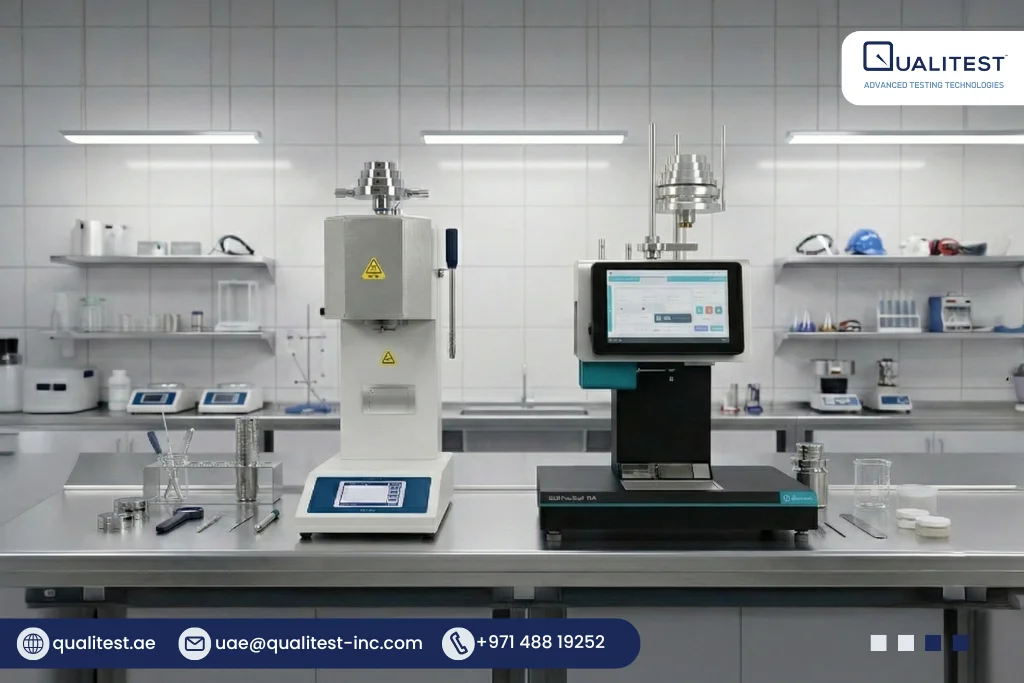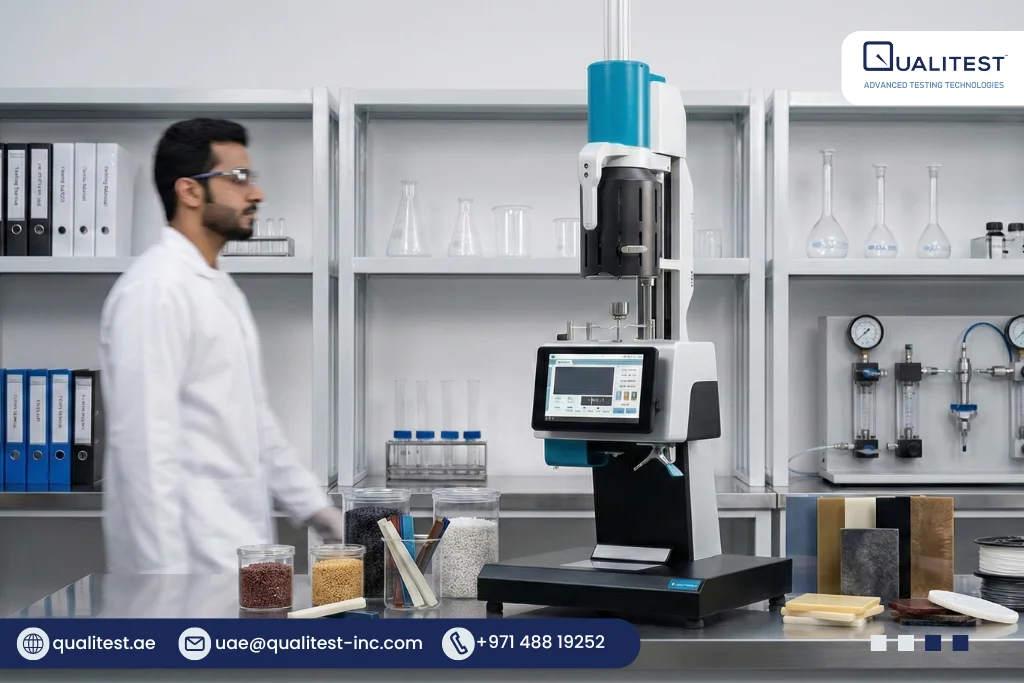


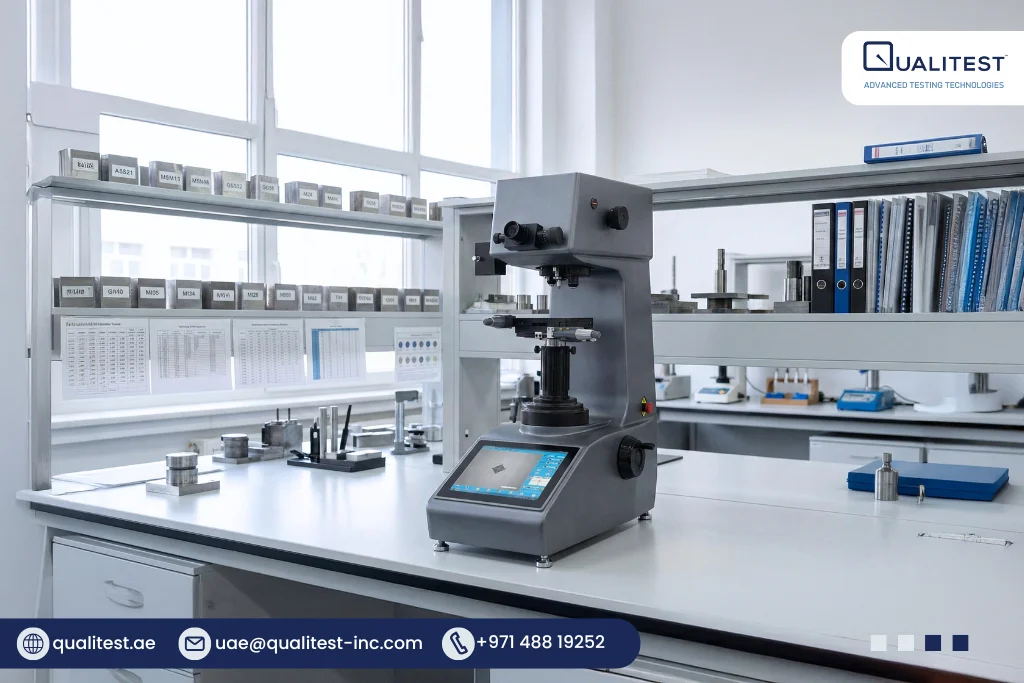
Here is the good news for your quality control budget. You often do not need to destroy a component just to verify its strength.
While the technical debate over is hardness testing destructive continues, the practical reality is much brighter.
At Qualitest, we help engineers in the GCC and Africa turn this distinction into a competitive advantage. The right approach allows you to gather accurate data while keeping your final products intact and ready for use.
(Will appear visible on live site)
Key Takeaways
- Standard indentation tests like Rockwell and Brinell are technically destructive because they physically alter the surface, while portable methods are often considered non-destructive.
- Benchtop testers provide the most consistent data for laboratory settings, but portable units like the QualiTip are essential for testing large equipment in the field.
- Choosing the wrong portable technology is a common mistake. Leeb testers are excellent for heavy parts but are unreliable for components under 5kg.
Is a Hardness Test Destructive or Nondestructive?
If we speak strictly by the book, then yes, conventional methods like Rockwell and Brinell are destructive.
The procedure involves pressing a hardened indenter into the material’s surface. Research confirms that indentation methods like Brinell, Vickers, and Rockwell leave a permanent indentation and can introduce local plastic deformation (Edwards, 2011). Because the component has been physically altered, it earns the “destructive” or at least “weakly destructive” classification.
In specific materials like glass, Vickers microhardness is explicitly described as destructive because the indentation alters the surface and may cause cracks (Santana et al., 2025). Similarly, testing metals relies on measuring the depth of a permanent change to the surface (Bejaxhin et al., 2019).
But from our professional standpoint, this is where the theory and the reality part ways.
So, is hardness testing non-destructive from a practical point of view? In our experience, the answer is often yes. When using a classic benchtop workhorse like the HR-150A Rockwell Tester, the indentation left is frequently so small that it has zero impact on the component’s performance.
Consider the logistics of inspecting a high-pressure pipeline in the Saudi desert or checking heavy mining excavators in West Africa. In these situations, cutting a sample to transport back to a lab is a logistical nightmare.
Here, a microscopic mark from a portable unit, such as our QualiTip Series, is a small trade-off for verifying safety without shutting down the entire operation. We believe that if the component can still perform its intended function without compromise, the “destructive” label is little more than a technicality.
Matching the Method to Your Application
We understand that for some applications, even a microscopic change is unacceptable. Fortunately, alternative methods exist that infer strength from rebound or wave propagation without significant damage.
For example, the Schmidt hammer is widely classified as a nondestructive test (NDT) for assessing concrete strength (Singh et al., 2024). We apply similar non-destructive principles to metal testing using Leeb and Ultrasonic technology. Newer micromagnetic techniques can even estimate hardness profiles nondestructively (Akhlaghi et al., 2020).
To help you determine if a hardness test is destructive or nondestructive for your specific requirements, here is a straightforward breakdown.
Our general recommendation is for clients to use a Benchtop method when circumstances allow. The physics of a large, stationary machine—like our precision QualiVick Series for Vickers testing—provide an unmatched level of stability. However, we are also acutely aware that bringing a multi-ton component into a lab is not always feasible.
| Testing Method | Machine Type | Does It Leave a Mark? | The Ideal Application For This |
|---|---|---|---|
| Rockwell / Brinell | Benchtop | Yes (A visible indentation) | Laboratory analysis, raw material validation, heavy castings, and test coupons where a minor mark is inconsequential. |
| Ultrasonic (UCI) | Portable | No (A microscopic footprint) | Fine-grained metals, thin-walled components, surface coatings, or polished parts that must remain visually perfect. |
| Leeb (Rebound) | Portable | No (A minor surface impact) | Large, heavy parts (over 5kg), solid metal structures, and on-site field inspections. |
These distinctions hit home for specific regional tasks. For instance, the HR-150A is often the standard for verifying raw steel imports at a UAE construction port before the building starts. On the flip side, the QualiTip is the practical choice for routine maintenance on an active oil rig where you cannot simply unbolt a flange and walk away with it.
A Common and Costly Mistake with Portable Testers
Deciding you need a non-destructive, portable solution is a good first step. However, this is the point where we see many organizations make a significant budget misstep.
There is a common assumption that all portable testers function in the same way. They do not. The operational difference between Ultrasonic (UCI) and Leeb (Rebound) technology is substantial. Attempting to use a rebound tester on a thin or lightweight component will almost certainly produce inconsistent and unreliable data.
It is our firm opinion that specifying a Leeb tester (like the QualiTip, which is designed for heavy, solid parts) for a small gear under 5kg is a false economy. The initial savings are quickly lost to inaccurate results.
We have a separate, detailed brief on the technical differences between UCI and Leeb. We strongly recommend reviewing it before making a procurement decision.
Why Regional Presence and Support Are Critical
Whichever technology you select, the value of your data depends entirely on properly calibrated, reliable equipment.
As the regional office for Qualitest North America, we provide a level of assurance that anonymous online vendors simply cannot match. We believe that in the demanding climates of the GCC and Africa (where heat and dust are constant operational factors) procuring equipment without local service support is an unnecessary business risk.
We don’t just supply equipment. We ensure it complies with critical international standards like ASTM E18 and ASTM A1038. Working with Qualitest means you have a local team for application support, technical advice, and service.
Qualitest: Your Partner in Practical Quality Control
We understand that every detail of your material’s integrity counts. Whether your process demands the pinpoint accuracy of a benchtop system or the field-ready flexibility of a portable unit, we provide cost-effective and dependable solutions.
Frequently Asked Questions
It depends on the method. Traditional methods like Rockwell, Brinell, and Vickers are considered “semi-destructive” because they leave a permanent indentation on the surface. However, portable methods like UCI (Ultrasonic Contact Impedance) are considered non-destructive (NDT).
In most industrial cases, yes. If the indentation from a Rockwell or Brinell test is placed on a non-critical area of the component, the part remains functional and safe to use.
UCI (Ultrasonic Contact Impedance) testers leave a microscopic indentation that is virtually invisible to the naked eye, making them the best choice for finished, high-value surfaces.
Ready to implement the right testing solution for your business? Explore our complete range of Hardness Testers and allow our team to help you select the ideal equipment for your application.
References
- Akhlaghi, I., Kahrobaee, S., Akbarzadeh, A., Kashefi, M., & Krause, T. (2020). Predicting hardness profile of steel specimens subjected to Jominy test using an artificial neural network and electromagnetic nondestructive techniques. Nondestructive Testing and Evaluation.
- Bejaxhin, A., Paulraj, G., & Prabhakar, M. (2019). Inspection of casting defects and grain boundary strengthening on stressed Al6061 specimen by NDT method and SEM micrographs. Journal of Materials Research and Technology.
- Edwards, J. (2011). Hardness Testing. Testing of the Plastic Deformation of Metals.
- Santana, G., et al. (2025). Nondestructive Hardness Assessment of Chemically Strengthened Glass. Optics.
- Singh, S., et al. (2024). Compressive Strength Prediction Model of High Strength Concrete by Destructive and Nondestructive Technique. E3S Web of Conferences.