
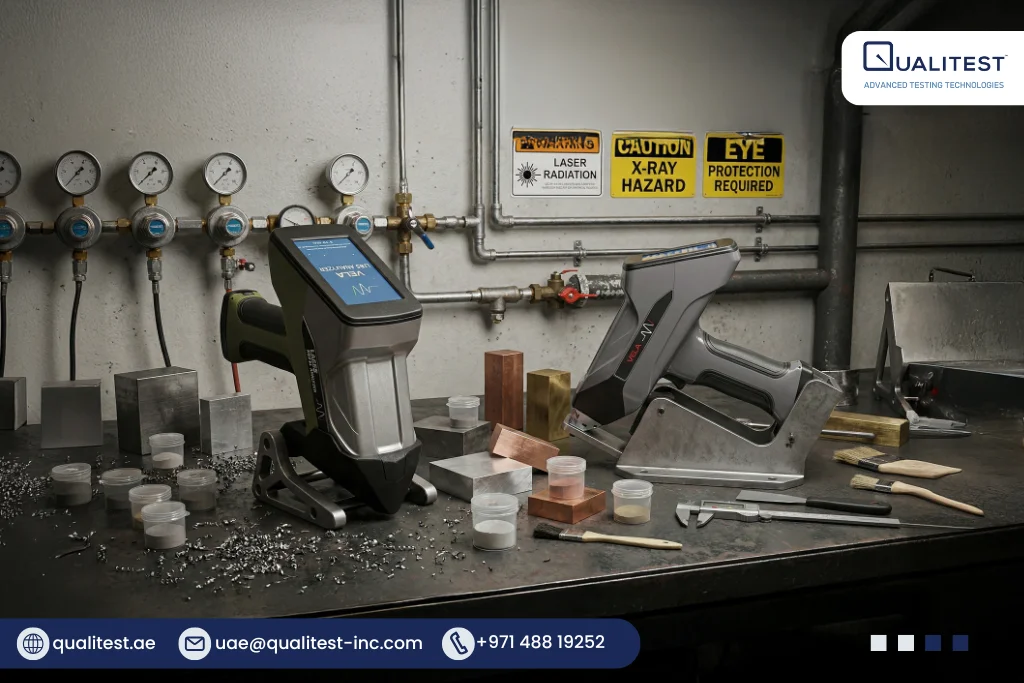
Choosing the incorrect analyzer for your operation is a costly error. Whether you are managing a scrap yard in Dubai or overseeing a pipeline project in South Africa, efficiency is the only metric that matters.
We know you have likely analyzed the technical sheets regarding the X-ray Fluorescence (XRF) versus Laser-Induced Breakdown Spectroscopy (LIBS) debate. At Qualitest, we frequently address this xrf vs libs discussion with our regional clients.
Let’s strip away the marketing noise. We are going to present a practical comparison of handheld libs vs xrf analyzers for metal sorting so you can determine which instrument belongs in your inventory.
(Will appear visible on live site)
Key Takeaways
- Speed vs. Precision: LIBS provides results in 1 to 2 seconds for high volume sorting while XRF takes longer to ensure stability for heavy alloys.
- The Carbon Factor: Only LIBS can detect Carbon which is essential for separating different grades of stainless steel like 304 and 304L.
- Sample Conditions: XRF works well on dirty or coated surfaces whereas LIBS requires a clean and ground surface to function correctly.
- Surface Impact: XRF is completely non-destructive for finished goods but LIBS leaves a tiny burn mark on the material.
- Our Recommendation: Use the QualiX XRF series for general recycling and precious metals or choose the Pegasus LIBS series for aluminum sorting and carbon analysis.
XRF or LIBS: The Technologies (Simplified)
What defines XRF?
Consider XRF as the heavy-duty workhorse of the testing industry. Technically, it is an analytical technique that uses X-ray tubes and detectors to identify and quantify elemental composition in materials (Lemière & Harmon, 2021; Ribeiro et al., 2021). Instruments like our QualiX-2000 Series represent this established reliability.
While XRF generally offers easier calibration and is widely used for routine elemental analysis, it is limited in detecting elements lighter than aluminum (Z=13) (Lemière & Harmon, 2021; Ribeiro et al., 2021).
What defines LIBS?
LIBS is the optical high-performer. It employs laser excitation to create plasma on the sample surface and analyzes the emitted light to detect elements (Lemière & Harmon, 2021; Rakovský et al., 2014). This method allows for the detection of light elements like lithium, carbon, and boron (Lemière & Harmon, 2021).
Models like the Pegasus and Vela Series utilize this modern approach to deliver rapid analysis. Although LIBS can be used in handheld or portable devices, it often requires careful calibration with matrix-matched standards to ensure accuracy (Lemière & Harmon, 2021; Rakovský et al., 2014).
The Operational Reality: LIBS vs XRF Performance Factors
When we examine the comparison of handheld libs vs xrf analyzers for metal sorting, we must evaluate how they function when the heat is high and the volume is immense. Here is our direct assessment of how the libs vs xrf battle plays out in the field.
1. Detection of Light Elements
This functional gap is where the two technologies diverge significantly. As noted in recent studies, XRF is limited when detecting elements lighter than aluminum (Lemière & Harmon, 2021; Ribeiro et al., 2021). XRF detectors often struggle because low-energy X-rays from light elements are absorbed by the air before reaching the sensor.
LIBS technology bypasses this limitation entirely. It is the undisputed specialist for identifying Lithium, Beryllium, and Magnesium with exceptional clarity. More importantly, it provides the Carbon values that are non-negotiable for separating L-grade from H-grade stainless steel.
Our View: If your profitability relies on separating Stainless 304 from 304L or calculating Carbon Equivalency (CE) for welding, the choice of xrf or libs is clear. Standard XRF is insufficient. You require the optical capability found in our Pegasus Series to quantify Carbon accurately and ensure material integrity.
2. Operational Speed
Time is a resource you cannot recover.
LIBS is exceptionally rapid; it generates a result in a mere 1–2 seconds. While that sounds only marginally faster than XRF on paper, the cumulative effect is massive. If you possess a sprawling stockpile of aluminum scrap, saving 5–8 seconds per test translates to hundreds of additional tests per shift. XRF generally requires a more deliberate duration, usually 3 to 10 seconds, to achieve a stable reading on complex alloys.
Our View: In a busy yard, waiting 10 seconds per scan accumulates into hours of lost productivity. When considering xrf vs libs for daily tonnage, the 1-second performance of a Vela Series handheld unit is the superior financial choice.
3. Surface Impact (Destructive vs. Non-Destructive)
XRF is entirely non-intrusive. It leaves absolutely no evidence on the sample. This is essential when testing finished valves, polished jewelry, or critical components that must remain aesthetically perfect. LIBS, however, creates a microscopic burn crater on the surface. While often invisible to the naked eye, it is technically a defect.
Our View: For raw scrap, a microscopic mark is irrelevant. But if you are verifying a finished aerospace component or high-value asset for a client, we advise utilizing the QualiX-2000. Using a laser on a finished part often invites unnecessary questions or quality disputes regarding surface damage.
4. The Practical Constraint: Sample Preparation
Here is the gritty reality that brochures often omit: scrap metal is rarely pristine. LIBS technology is sensitive and demands direct contact with clean metal. Because it is an optical technique, if the surface has rust, paint, or oxidation, the laser will analyze the contamination rather than the alloy. This forces the operator to grind every single test spot.
XRF is far more forgiving. Its high-energy X-rays can frequently penetrate through moderate oil, water, or surface film to get a reliable reading without immediate preparation. Additionally, scientific reviews highlight that XRF generally offers easier calibration for routine analysis compared to LIBS (Carvalho et al., 2018; Rakovský et al., 2014).
Our View: Ask yourself seriously if your operators will consistently carry a grinder and prep every sample. If the answer is negative, XRF offers the more consistent user experience. Buying a fast LIBS unit only to slow down for grinding defeats the purpose.
5. Regulatory Requirements
The administrative difference is also worth noting. XRF utilizes ionizing radiation, which often compels regional authorities in the GCC and Africa to require registration, dosimeters for staff, and strict storage protocols. LIBS utilizes a Class 3B laser, meaning the administrative burden is generally significantly lower and usually limited to basic eye safety training.
Our View: If you need to move equipment across African borders frequently or operate in regions with strict radiation controls, the reduced paperwork associated with a Pegasus or Vela unit can prevent significant logistical headaches and project delays.
The XRF vs LIBS Decision Matrix
To assist you in deciding between xrf or libs, here is the technical summary:
| Factor | Handheld XRF | Handheld LIBS |
|---|---|---|
| Primary Advantage | Heavy elements, High-Temp Alloys | High throughput, Light elements (Carbon) |
| Carbon Capability | Negative (generally) | Affirmative (Excellent) |
| Analysis Duration | Moderate (3–10 Sec) | Rapid (1–3 Sec) |
| Surface Tolerance | High (forgives surface film) | Low (requires clean metal) |
| Compliance | High (Radiation protocols) | Low (Laser safety) |
XRF or LIBS: Which Instrument Should You Procure?
What type of manager invests in tools that do not match the application? It depends entirely on your specific objectives. In fact, experts agree that the two techniques are complementary depending on the application (Lemière & Harmon, 2021; Carvalho et al., 2018).
Select XRF (QualiX-2000 Series) if:
- You require absolute precision for heavy elements like Tungsten or Lead.
- You are inspecting finished goods and cannot alter or mark the surface.
- You are testing catalytic converters for Platinum, Palladium, or Rhodium.
- You work with precious metals (Gold, Silver) and need non-destructive verification.
- You prefer a “point-and-shoot” simplicity without mandatory grinding of dirty scrap.
Select LIBS (Pegasus or Vela Series) if:
- You must quantify Carbon content in steel grades or calculate Carbon Equivalency (CE).
- You are sorting Aluminum, Magnesium, or Titanium alloys and require maximum throughput.
- You are involved in Lithium-ion battery recycling (LIBS detects Lithium).
- You need a device that is lighter and more ergonomic for all-day usage.
- You prefer to avoid the administrative tasks and licensing associated with radiation devices.
Optimize Your Metal Sorting with Qualitest
At Qualitest, we believe you should pay for performance, not inflated brand marketing. We have selected a range of analyzers that are durable and economically sensible for the Middle East and African sectors.
Whether the choice is xrf or libs, we can guide you to the correct solution. We do not simply supply units; we ensure your testing process is efficient and profitable.
Frequently Asked Questions
Handheld XRF struggles with light elements (Mg, Al, Si) due to physics limitations. LIBS is much better suited for sorting Aluminum and Magnesium alloys.
XRF uses ionizing radiation (X-rays) and requires strict safety regulations. LIBS uses a laser (Class 3B), which requires safety glasses but generally has fewer regulatory hurdles than X-ray devices.
For heavy metals (Stainless, Copper, Nickel alloys), XRF is the industry favorite due to its ease of use. For Aluminum scrap sorting, LIBS is the superior choice.
Contact us today. Let us discuss your specific requirements, and we will provide a competitive quotation.
References
- Carvalho, G., et al. (2018). Recent advances in LIBS and XRF for the analysis of plants. Journal of Analytical Atomic Spectrometry, 33, 919-944.
- Lemière, B., & Harmon, R. (2021). XRF and LIBS for Field Geology. 455-497.
- Rakovský, J., et al. (2014). A review of the development of portable laser induced breakdown spectroscopy and its applications. Spectrochimica Acta Part B: Atomic Spectroscopy, 101, 269-287.
- Ribeiro, R., et al. (2021). X-ray Fluorescence and Laser-Induced Breakdown Spectroscopy Analysis of Li-Rich Minerals in Veins from Argemela Tin Mine, Central Portugal. Minerals.