
Identifying the exact alloy sitting in front of you is a critical business function, not just a technical checkbox. Getting the chemistry wrong in a fabrication shop or scrap yard burns profit margins fast. Whether you operate in the Middle East or Africa, picking the right analyzer is a major operational decision.
The main contenders are Optical Emission Spectroscopy (OES) and Laser Induced Breakdown Spectroscopy (LIBS). At Qualitest, we frequently guide clients through the LIBS vs OES debate. While both find elemental composition, they work differently. Choosing the wrong one creates bottlenecks.
Here is our candid OES vs LIBS comparison to help you secure the best ROI.
(Will appear visible on live site)
Key Takeaways
- Speed vs Precision: Choose LIBS for fast and handheld sorting in the field. Select OES for high-precision laboratory analysis and certification.
- Carbon Detection: OES remains the mandatory standard for certifying low-carbon (L-grade) stainless steel and detecting trace elements like Phosphorus or Sulfur.
- Operational Costs: LIBS reduces daily overhead by running on batteries without Argon gas. OES requires gas for operation but justifies the cost through unmatched accuracy.
- Local Support: Buying reliable equipment in the GCC and Africa requires a partner like Qualitest to provide regional service and ensure rugged durability against heat and dust.
Defining the Technology: LIBS vs OES
Before analyzing the pros and cons, let’s clarify the mechanism behind each tool to better understand the LIBS vs OES landscape.
Optical Emission Spectroscopy (OES)
OES (Optical Emission Spectrometers) is the established standard for high-performance metal analysis. Technically, this method relies on plasma generated by electrical discharges to excite atoms and ions, producing emission spectra for elemental analysis commonly used in metallurgical settings (Bengtson, 2017; Zhang et al., 2014).
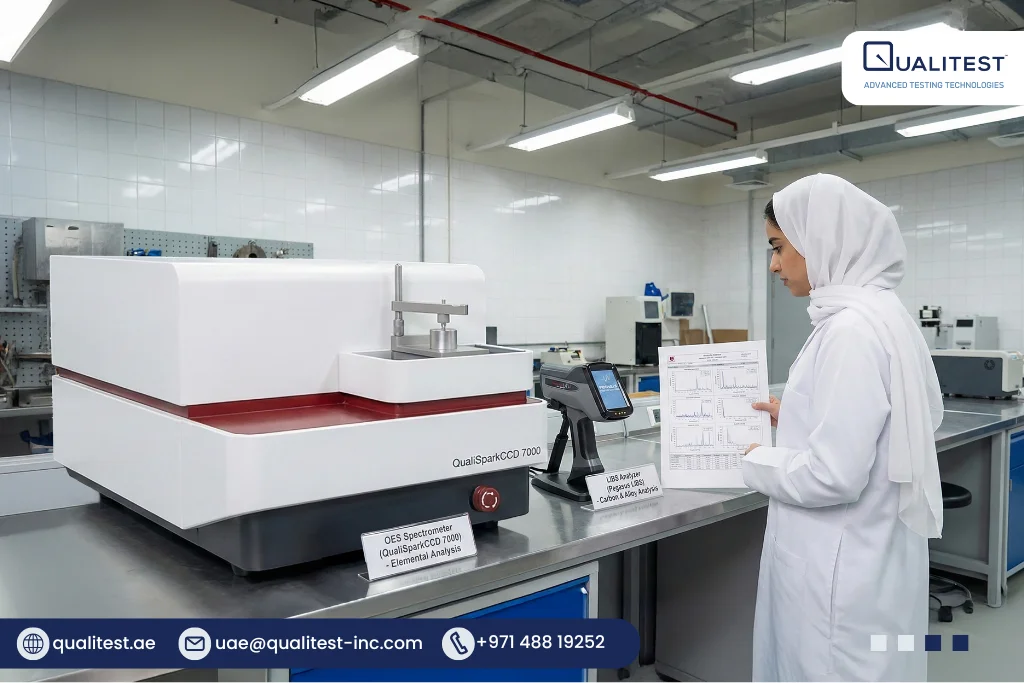
This technology is renowned for its capability to detect light elements like Carbon, Boron, Phosphorus, Sulfur, and Nitrogen with extreme sensitivity. Instruments like our Full-Spectrum Spark OES QualiSparkCCD 7000 are designed specifically for this level of detail. While LIBS offers better spatial resolution, spark OES generally offers faster analysis, higher precision, and easier quantification for bulk metal analysis (Bengtson, 2017; Zhang et al., 2014).
Laser Induced Breakdown Spectroscopy (LIBS)
LIBS (Laser Induced Breakdown Spectroscopy) is the modern, agile alternative. It functions by using a focused laser pulse to create a plasma on the sample surface, emitting light characteristic of the elements present (Saeidfirozeh et al., 2024; Thomas & Joshi, 2023; Fichet et al., 2006).
LIBS is favored for its speed and compact design. It offers localized analysis with minimal sample preparation and can analyze almost any material shape or size (Saeidfirozeh et al., 2024; Thomas & Joshi, 2023; Fichet et al., 2006).
Our Vela Series handheld units, for example, are engineered to be lightweight and fast. This offers a significant upgrade in workflow efficiency for field operators who need immediate results.
The Operational Snapshot: OES vs LIBS
For a quick assessment of which technology fits your workflow in the OES vs LIBS debate, here is how they compare directly:
| Feature | Handheld LIBS | Mobile/Stationary OES |
|---|---|---|
| Primary Benefit | Speed & Mobility | Analytical Accuracy |
| Carbon Analysis | Possible (e.g., Pegasus Series) | Superior (Required for L-grade Steels) |
| Argon Dependency | None | Yes (Required) |
| Surface Prep | Critical (Must be clean) | Mandatory (Grinding required) |
| Ideal Use Case | Scrap Sorting, Pipeline Inspection | Foundries, Labs, QA/QC |
| Running Cost | Minimal | Moderate (Gas consumables) |
LIBS vs OES: The Practical Differences
The table provides the data, but the operational reality is often different. When our clients in the GCC and Africa ask about the practical distinction between OES vs LIBS, we look past the brochure specifications and focus on field application.
1. Mobility and Field Use
If your main objective is moving freely across a job site, the LIBS vs OES discussion settles quickly.
- LIBS: These units are genuine handheld tools that resemble a barcode scanner. They operate on batteries and function without external gas cylinders. Academically, LIBS is noted as advantageous for in situ, rapid, and portable analysis (Bengtson, 2017; Zhang et al., 2014). This allows technicians to climb scaffolding or inspect pipelines in remote desert locations without hindrance. We believe that for high-volume sorting, operator fatigue is a real factor. A lightweight unit like the Vela Series keeps your team productive for longer shifts.
- OES: While mobile OES units are available, they are substantial pieces of equipment. They typically involve a probe tethered to a main unit and require an Argon gas tank. OES remains preferred for routine, automated industrial applications due to its speed and robustness (Bengtson, 2017; Zhang et al., 2014). We classify mobile OES as “transportable” rather than truly “handheld.” However, if mobility is secondary to performance, the lack of agility is a reasonable exchange for the analytical power provided.
2. The Carbon Factor
This is frequently the deciding element in the OES vs LIBS evaluation.
- OES: If you must verify low levels of Carbon (C) in L-grade stainless steel, or need to track Phosphorus and Sulfur with high precision, OES is the superior option. The argon purge creates a stable atmosphere that allows the sensor to read those light elements accurately. We frankly advise our foundry clients: if your business reputation relies on certifying 316L stainless steel, stick with a high-end OES like the QualiSparkCCD 7000.
- LIBS: Technology is advancing, and premium models like our Pegasus Series can now read Carbon effectively. However, they generally struggle to match the ultra-low detection limits of a stationary OES. For general grade identification, LIBS is effective. However, we hold the view that for critical safety applications, relying solely on handheld LIBS for carbon equivalent calculations requires careful validation.
3. Surface Preparation and Versatility
In the comparison of LIBS vs OES, LIBS is often promoted as “point and shoot,” but we always remind customers that physics still applies.
- LIBS: The laser targets a microscopic spot. LIBS offers better spatial resolution and can analyze small or irregular samples compared to OES (Bengtson, 2017; Zhang et al., 2014). In fact, LIBS is increasingly used in new fields such as environmental monitoring and space missions where its flexibility and minimal sample prep are critical (Saeidfirozeh et al., 2024; Yümün & Kam, 2019). However, because the analysis area is so small, surface contaminants like paint, rust, or oil will skew the results. We emphasize during training: if you do not clean the test spot thoroughly, you are analyzing the corrosion, not the alloy.
- OES: This method burns a larger area, providing a better average reading of the material. Yet, to achieve the high precision OES is famous for, the sample surface must be ground flat to ensure a proper seal.
4. Operational Costs
For companies operating in the competitive GCC and African markets, controlling expenses is vital when calculating the LIBS vs OES ROI.
- LIBS: Generally incurs lower running costs as it does not consume Argon gas. Maintenance is straightforward, primarily involving keeping the optical window clean.
- OES: Requires a consistent supply of high-purity Argon gas, which adds to operational overhead. However, we believe this expense is negligible compared to the financial impact of a rejected shipment. For routine process monitoring, a cost-effective workhorse like the OES QualiSpark 1000 provides a reliable balance between budget and performance.
Real-World Scenarios: OES vs LIBS in Action
Technical specs are useful, but let’s visualize how the LIBS vs OES choice plays out on the ground. Consider these two typical industrial situations where the superior option becomes obvious.
The High-Volume Scrap Yard
Picture a bustling recycling facility in a hot, dusty industrial zone. A massive shipment of mixed aluminum and copper scrap has just been dumped, and the team needs to sort it immediately to clear the floor. The heat is oppressive, and there are hundreds of pieces to process. In this LIBS vs OES standoff, the LIBS (Vela Series) is the undisputed winner. You simply do not have the time to grind every single piece or drag a gas tank through the yard. You grab the handheld unit, aim it at the metal, zap it, and toss it in the correct bin. It handles the sheer volume efficiently without slowing down operations.
The High-Stakes Fabrication Shop
Now, imagine a fabrication shop supplying valves for a high-pressure oil rig. The client specifications are rigid. They demand an exact Carbon count to ensure the steel won’t crack under extreme pressure, and a third-party inspector is waiting for a certified report. Here, the OES vs LIBS choice is clear: absolute certainty is the goal. A handheld unit might provide a “close enough” reading, but “close enough” causes accidents in this sector. You need the OES (QualiSparkCCD 7000) to burn that sample and prove, without a shadow of a doubt, that the Carbon content is within the safe limit.
OES vs LIBS: The Decision
Here is the bottom line for procurement managers and engineers weighing LIBS vs OES:
- Select LIBS if: You require speed and portability. If you are primarily sorting alloys where ultra-low carbon specifications are not the primary concern, a Vela or Pegasus unit is the optimal tool for scrapyards and inspectors working at difficult heights.
- Select OES if: Precision is your absolute priority. If you operate a foundry, a steel plant, or a QA/QC lab where you must certify carbon content or trace elements, the QualiSpark series is the mandatory choice.
Partner with Qualitest for Reliable Analysis
At Qualitest, we know the Middle East and Africa markets. Buying analytical equipment is a capital investment, and the biggest risk is after-sales support. We see too many businesses stranded with “grey market” units and no local service.
Qualitest.ae is your regional partner. We ensure our LIBS vs OES equipment is rugged enough for Gulf heat and African mining dust. From the agile Vela and Pegasus LIBS units to the robust QualiSpark OES series, we offer cost-effective, durable solutions backed by local technical guidance.
Frequently Asked Questions
OES (Optical Emission Spectroscopy) is traditionally the gold standard for measuring Carbon, especially in L-grade Stainless Steel. However, advanced LIBS handhelds are catching up but are generally used for screening.
Most handheld LIBS analyzers use a laser and do not require Argon gas, making them cheaper to operate. OES units (even portable ones) typically require an Argon tank to function accurately.
LIBS is generally faster (1-3 seconds) and requires minimal sample preparation. OES typically requires a cleaner, flatter surface grind, taking slightly longer to prep.
Don’t risk your quality control. Contact us today to find the right budget-friendly solution for your specific application.
Explore our LIBS Analyzers | View our OES Spectrometers
References
- Bengtson, A. (2017). Laser Induced Breakdown Spectroscopy compared with conventional plasma optical emission techniques for the analysis of metals – A review of applications and analytical performance. Spectrochimica Acta Part B: Atomic Spectroscopy, 134, 123-132.
- Fichet, P., Tabarant, M., Salle, B., & Gautier, C. (2006). Comparisons between LIBS and ICP/OES. Analytical and Bioanalytical Chemistry, 385, 338-344.
- Saeidfirozeh, H., Kubelík, P., Laitl, V., Křivková, A., Vrábel, J., Rammelkamp, K., Schröder, S., Gornushkin, I., Képeš, E., Žabka, J., Ferus, M., Pořízka, P., & Kaiser, J. (2024). Laser-Induced Breakdown Spectroscopy in Space Applications: Review and Prospects. TrAC Trends in Analytical Chemistry.
- Thomas, J., & Joshi, H. (2023). Review on laser-induced breakdown spectroscopy: methodology and technical developments. Applied Spectroscopy Reviews, 59, 124 – 155.
- Yümün, Z., & Kam, E. (2019). Silivri (İstanbul) ve Çanakkale Boğazı Arasındaki Denizel Sedimanların Element Konsantrasyonlarının ICP-OES ve LIBS Yöntemleri İle Analizi ve Korelasyonu.
- Zhang, Y., Jia, Y., Jiwen, C., Shen, X., Liu, Y., Zhao, L., Li, D., Han, P., Xiao, Z., & , H. (2014). Comparison of the Analytical Performances of Laser-Induced Breakdown Spectroscopy and Spark-OES. Isij International, 54, 136-140.