

Finding the perfect Melt Flow Index (MFI) tester is easier than you think.
You don’t need to drown in technical specs; you just need the right fit for your lab’s specific rhythm. Whether you are eyeing a manual workhorse or a high-speed automatic system, we are here to help you make a choice that boosts your efficiency and fits your budget.
Let’s look at the real-world manual vs automatic MFI options so you can get back to what matters: quality production.
(Will appear visible on live site)
Key Takeaways
- Manual Testers (Procedure A) are the most practical, cost-effective choice for startups or labs with low testing volumes.
- Automatic Testers (Procedure B) are essential for high-demand sectors like pipe manufacturing to eliminate human error and boost efficiency.
- Research Confirmation shows that automatic units deliver superior repeatability with less than 2% error compared to manual methods.
- Regional Suitability matters, which is why our equipment is built to withstand the specific heat and dust conditions of the GCC and African regions.
- Local Support is a key advantage when partnering with Qualitest, ensuring you get technical help in your own time zone.
First, a Quick Word on the Official Methods (ASTM D1283)
Before choosing a machine, it’s helpful to know the procedures they run. The industry standard, ASTM D1283, outlines two main approaches:
- Procedure A (The Operator-Driven Method): This involves the technician directly cutting the extruded polymer and weighing the samples to determine the flow rate.
- Procedure B (The Automated Method): This uses a sensor to measure piston movement over time, which automatically calculates the flow rate with minimal human input.
Manual Melt Flow Testers: The Dependable Workhorse
Manual testers are the foundation of countless labs. The process is straightforward: an operator loads the material, applies the specified weight, and manually cuts the extrudate at timed intervals.
Key Advantages:
- A Sensible Investment: These machines come with a lower initial cost, making them a very practical choice for new facilities or labs managing a tight budget.
- Engineered for Durability: Their simpler construction involves fewer complex electronics, so they are exceptionally reliable and easy to maintain.
- Ideal for Lower Throughput: If your lab runs only a few MFI tests per week for verification, a manual tester is often the most logical tool for the job.
An Illustrative Scenario:
A good example of where a manual tester excels would be a specialized masterbatch producer in a free zone like JAFZA, or a small injection molding facility in an industrial park in Lagos. These businesses might need to check the MFI of a new color batch or verify an incoming raw material a few times a day.
For this scale of operation, a manual tester provides the essential data they need to ensure quality without the higher capital outlay of an automatic system. It is a practical, cost-effective tool for essential QC.
The Practical Limitations:
The primary variable in manual testing is the potential for human error. The final result is directly influenced by the operator’s consistency with timing and cutting.
A Word of Caution from Our Team:
We have seen data variability become an issue in facilities with multiple shifts and different operators. The consistency of a manual machine is tied to the consistency of its user. For operations where operator variance is a concern, we generally recommend a system that removes that variable.
Our Recommended Solution:
For labs seeking a reliable and cost-effective instrument, our QualiFi-2000 Series is an excellent starting point. It performs to standard, is built to last, and is simple to operate.
Automatic Melt Flow Testers: The Efficiency-Focused Solution
When testing volume increases, the need for faster, more repeatable results becomes critical. Automatic testers are designed for this purpose because they automate the timing and data collection process to improve precision.
As noted in industry research, modern automatic units have evolved beyond simple graders to become “powerful polymer analyzers” capable of evaluating melt density, filler content, and thermal stability (Locati et al., 1996). This expanded capability allows you to gather deeper insights into your materials beyond just the flow rate.
Tailored for Demanding Regional Industries:
For the packaging and pipe manufacturing sectors across Saudi Arabia, the UAE, and South Africa, material consistency is fundamental. When working with materials like HDPE and PP, precise MFI values are not negotiable.
An Illustrative Scenario:
Let’s imagine a typical case for a major polymer producer in a hub like Jubail or Ruwais, running dozens of quality checks per shift on different polyethylene grades. Or think of the demands on a pipe manufacturer in Egypt supplying a massive new infrastructure project. In these high-volume environments, an operator manually cutting samples becomes a bottleneck and a source of potential error.
An automatic tester is not just a convenience. It is essential for maintaining the production pace and ensuring every batch meets strict client specifications. The same logic applies to the growing recycling industry in Kenya and Nigeria, where an automatic tester’s precision is critical for managing the variable flow rates of post-consumer resin.
Key Advantages:
- Exceptional Repeatability: Research indicates that automatic testers can achieve melt flow rate measurements with errors of less than 2% compared to manual methods (Gufeng, 2011). By using encoders and automated cutters, these machines produce results that are consistent test after test.
- Significant Workflow Efficiency: The system calculates MVR and MFR automatically. This frees up your technicians to perform other valuable tasks.
- Integrated Data Management: Advanced models provide software for logging, analyzing, and reporting data, which is invaluable for traceability and quality audits.
Our Advanced Solutions:
- QualiFi-5000 Galaxy Series: A powerful instrument designed for higher throughput and demanding materials.
- QualiFi-6000G Auto: Our premier system featuring enhancements like automatic weight lifting for maximum operator ease and safety.
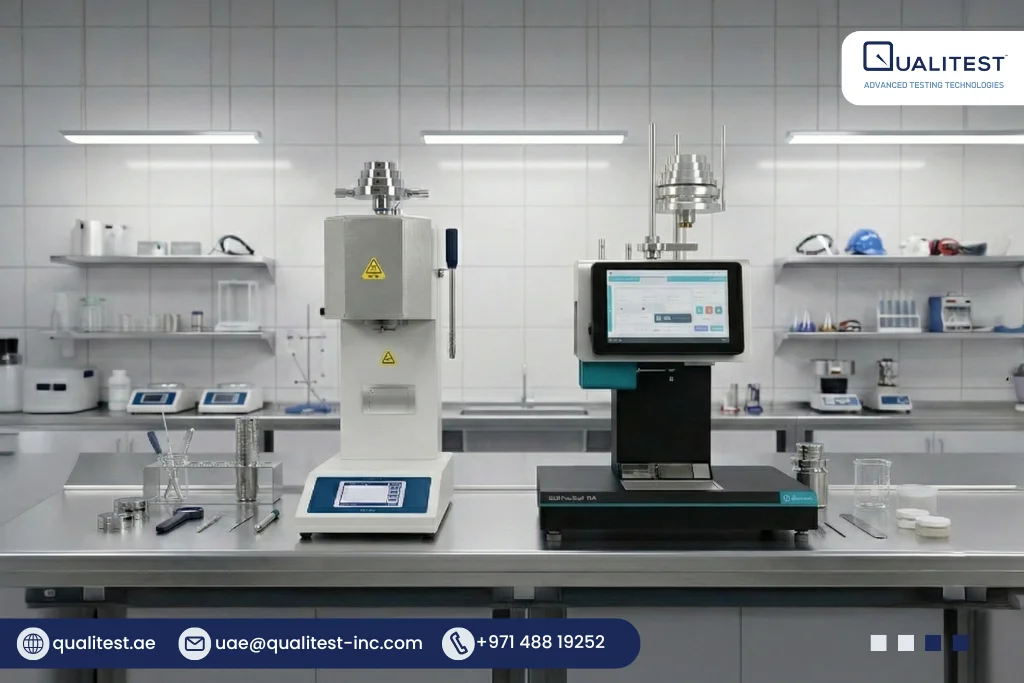
A Direct Comparison
Here is a clear summary to help you evaluate which direction is right for your lab.
| Feature | Manual Tester (QualiFi-2000) | Automatic Tester (QualiFi-5000/6000) |
|---|---|---|
| Initial Investment | Low (Budget-conscious) | Moderate to High |
| Operator Skill Level | Requires a trained, focused user | Minimal training needed |
| Test Methods | Procedure A (Operator-driven) | Procedure A & B (Both methods) |
| Data Consistency | Good (Dependent on operator) | Excellent (Machine-controlled) |
| Best Suited For | Routine verification, low volume | High volume, R&D, stringent QC |
The Final Verdict: How to Choose
Our guidance is straightforward: don’t over-invest in automation you won’t use, but don’t compromise on precision if your product quality depends on it.
If your lab runs a high volume of samples or must adhere to Procedure B, an Automatic tester is a sound investment that delivers returns in labor efficiency and data confidence. For standard quality checks and labs with more modest budgets, a Manual tester remains an industry-standard, reliable solution.
Why Partner with Qualitest?
We live and work in the same region you do, so we get it.
- Built Tough: Our machines handle the Gulf heat and factory dust without breaking a sweat.
- Local Support: No 3 AM calls to overseas support. We are in your time zone, ready to help.
- Cost-Effective: From the basic QualiFi-2000 to the pro QualiFi-6000G Auto, you get top-tier performance without the inflated price tag.
Frequently Asked Questions
The primary advantage is consistency and safety. Automatic models handle the weight lifting and sample cutting automatically, removing human error and reducing the risk of burns for the operator.
Choose automatic if you run a high volume of tests daily or need to measure multiple weights (Multi-Weight test) in a single sequence. For occasional testing, a manual model is cost-effective.
Yes, both Qualitest manual and automatic MFI series are fully compliant with ASTM D1238 and ISO 1133 standards for Procedures A and B.
Ready to Improve Your Testing Process? Choosing the right equipment is a critical step in streamlining your quality control. We invite you to explore our range of melt flow indexers to find the instrument that best fits your operational needs.
[View Our Melt Flow Tester Solutions Here]
References
- Gufeng, C. (2011). Automatic Determination of Melt Flow Rates of PS and ABS. China Plastics.
- Locati, G., Poggio, S., & Rathenow, J. (1996). The new melt flow rate testers: Not merely graders… but powerful polymer analyzers. Polymer Testing, 15, 443-454.