


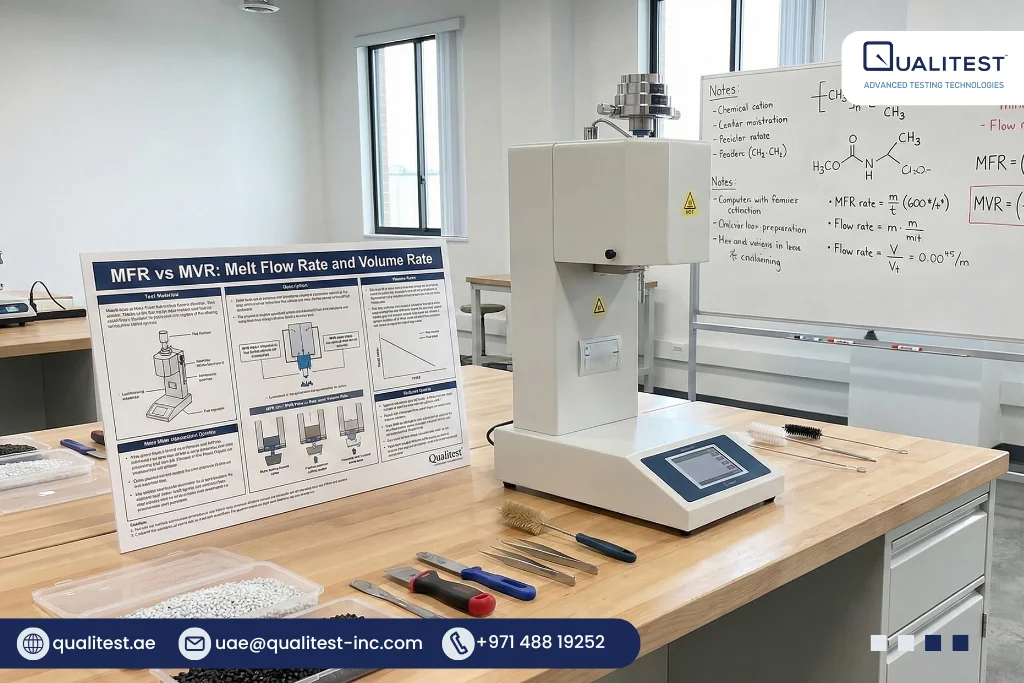
A clear understanding of your polymer’s flow characteristics is foundational to an efficient production line. At the center of this are two key metrics that are a common point of confusion: Melt Flow Rate (MFR) and Melt Volume Rate (MVR). While they appear similar, the MVR vs MFR distinction is a critical one for process control.
This guide will clarify the core differences, the real-world variables supported by technical research, and explain how to convert MVR to MFR.
(Will appear visible on live site)
Key Takeaways
- Understand the Core Difference: Melt Flow Rate (MFR) measures mass in grams while Melt Volume Rate (MVR) measures volume in cubic centimeters.
- Know When to Use Which: MVR is often the more reliable choice for materials with fillers since it is independent of density changes.
- The Conversion Formula: You can convert MVR to MFR simply by multiplying the MVR value by the material’s melt density.
- Watch for Interferences: High moisture content or thermal degradation will artificially increase your flow rate readings and mislead your quality control.
- Prevent Production Defects: Regular testing allows you to catch out-of-spec batches before they cause flash or warping in your molding machines.
MFR vs. MVR: What’s the Core Difference?
The primary separation between MFR and MVR comes down to what each one is actually measuring. Two key metrics, both determined using a standard tester like our MFI Melt Flow Indexer QualiFi-2000 Series, are:
Melt Flow Rate (MFR) is a measurement of mass. It quantifies how much material, by weight, pushes through a standard die over a 10-minute period. The result is given in grams per 10 minutes (g/10 min).
Melt Volume Rate (MVR), conversely, is not concerned with the material’s mass. It measures the volume of polymer that moves through that same die. This result is expressed in cubic centimeters per 10 minutes (cm³/10 min).
Research confirms that MFR is a mass-based measure while MVR is a volume-based measure of flowability (Rides et al., 2009; Liang et al., 2015). In our experience, for materials that include fillers, MVR often provides a more stable and reliable indicator of flow.
Here is a straightforward comparison:
| Attribute | Melt Flow Rate (MFR) | Melt Volume Rate (MVR) |
|---|---|---|
| What It Measures | The material’s mass in motion | The material’s volume in motion |
| Unit of Measurement | grams/10 min | cubic cm/10 min |
| Key Dependency | Requires melt density for context | A self-contained measurement |
| Best Suited For | Unfilled, uniform polymers | Materials with fillers or density variations |
The Impact on Your Production Floor
This is where technical specifications translate directly into operational results. Knowing the MFR vs MVR numbers isn’t just for a spec sheet; it’s a practical tool for preventing production issues before they happen.
- For Injection Molding: Every processor knows the challenge of material inconsistency. A polymer with the correct flow properties will fill every detail of a mold with precision. By checking the MVR of a new material lot (perhaps using the advanced touch-screen interface of the MFI Melt Flow Indexer – QualiFi-5000 Galaxy Series for quick data entry) you can identify potential problems and prevent a run of costly defects.
- For Extrusion: When producing items like pipes or profiles, you need the extruded material to maintain its intended shape as it cools. A lower MFR/MVR number indicates a higher melt strength, which is essential for preventing the profile from sagging or deforming.
Consider this practical scenario:
A company in the Jebel Ali Free Zone, Dubai, is injection molding high-pressure pipe fittings for a major regional construction project. The spec sheet requires a material with an MVR of 15 +/- 2. This is their established process window.
A new batch of raw material from a supplier arrives. They run a quick test and the MVR comes back at 21.
Before that material ever enters the machine, they know it is significantly out of spec. An MVR of 21 indicates a material that is far more “runny” than what their process is designed for, likely leading to flash and fittings that fail under pressure testing. They’ve just prevented a significant amount of scrap and potential project delays with one simple test.
What Actually Influences Your Results?
If you see a sudden spike or drop in your numbers, don’t panic. Instead, look for these common culprits. The results of MFR and MVR are significantly influenced by testing conditions and material composition.
Moisture
This is the “silent killer” of accuracy, especially in the humid coastal areas of the GCC or West Africa. If your material (like PET or Nylon) isn’t dried properly, the moisture turns to steam in the barrel. This acts like a lubricant and causes the material to shoot out faster, giving you a fake high MFR reading.
Studies show that controlling drying and temperature history is essential to improve the repeatability and reproducibility of MFR and MVR tests for moisture-sensitive polymers (Rides et al., 2009; Spicker et al., 2019).
Fillers and Additives
Glass fibers or mineral fillers don’t flow; they just go for the ride. Generally, additives like magnesium hydroxide or microencapsulated red phosphorus can decrease flow rates by increasing melt resistance (Lee et al., 2016; Liang et al., 2015; Liang et al., 2010).
Similarly, polymer composites containing kenaf fiber or silica nanoparticles show altered flow properties due to changes in chain entanglement and flow resistance (Lee et al., 2016; Hadi & Mohamed, 2016; Hadi & Mohamed, 2015). This is why MVR is often preferred for filled grades: it ignores the density changes caused by the heavy filler and focuses on how the volume is moving.
Degradation
This is a factor that often catches operators off guard. If the material sits in the heated barrel for too long—perhaps during an unexpected line stoppage or an extended lunch break—the heat begins to attack the polymer structure.
This thermal history causes the long molecular chains to snap (a process known as chain scission). Since shorter chains flow much more freely than long ones, the viscosity drops, and you end up with a significantly higher MFR/MVR than the material actually possesses.
It creates a “false positive” where degraded material might look like it has high flow, but in reality, its structural integrity has been compromised.
The Standards You Need to Know (ASTM vs. ISO)
To keep these variables in check, you have to follow the rulebooks. Generally, you will be working with one of two major standards, and knowing the difference matters.
- ASTM D1238: This is the go-to standard for North America. It typically calls for a preheat time of about 7 minutes.
- ISO 1133: This is the standard you’ll see globally, and it is the prevalent standard used across the GCC and most of Africa. It usually specifies a shorter preheat time of 5 minutes and tends to favor MVR for its volumetric focus.
- Our advice: Never assume these two are interchangeable. Whether you are adhering to ASTM or ISO, precise control over temperature and timing is non-negotiable. High-precision units, such as the Melt Flow Indexer – QualiFi-6000G Auto, are designed specifically to handle these varying parameters without user error, ensuring your compliance regardless of the standard used.
How to Convert MVR to MFR
Translating between these two values is not complicated. The link is the material’s melt density. As noted in the literature, MFR and MVR are related by the melt density, where MFR = MVR × melt density (Rides et al., 2009; Liang et al., 2015).
A word of caution we always offer our clients: the accuracy of your MFR value is completely dependent on the quality of your melt density data. An imprecise density input will yield an equally imprecise MFR result.
For example, let’s look at a SABIC or Borouge-produced grade of Polypropylene commonly used for packaging applications here in the GCC:
- You run a test and find the MVR is 12 cm³/10 min.
- You know the melt density (ρ) for this specific grade is 0.75 g/cm³.
- The calculation is: MFR = 12 cm³/10 min x 0.75 g/cm³ = 9 g/10 min.
It’s a simple calculation that directly links the volume of flow to the mass of flow.
Interpreting the Relationship Between MVR and MFR
Instead of asking how to calculate the difference from MVR and MFR, the more valuable question is what the relationship between them reveals. The gap isn’t a problem to be solved, but a piece of information to be used. MFR and MVR provide complementary insights into polymer melt behavior (Rides et al., 2009).
If the MFR number is considerably higher than the MVR, it’s an indicator that your material is quite dense in its molten state. It’s a valuable clue about the material’s behavior under processing conditions.
Qualitest: Your Partner in Polymer Testing
We understand that consistent, reliable material data is critical to your operational success. That’s why we supply dependable, straightforward testing equipment designed to give you the clear numbers you need to maintain control.
Frequently Asked Questions
MFR (Melt Mass-Flow Rate) measures the weight of the material extruded in grams (g/10min), while MVR (Melt Volume-Flow Rate) measures the volume in cubic centimeters (cm³/10min).
MVR is preferred when the density of the material changes significantly during the molten state. It is also faster to measure since no weighing of the cut sample is required if the machine has an encoder.
Yes, if you know the melt density of the material at the test temperature. The formula is: MFR = MVR × Melt Density.
If you are ready to move from guessing to knowing exactly how your materials will perform, contact our team. We can assist you in selecting the right Melt Flow Tester to meet your quality control goals.
References
- Hadi, N., & Mohamed, D. (2015). Study the relation between rheological , thermal and mechanical properties of waste polypropylene filled silica nanoparticles.
- Hadi, N., & Mohamed, D. (2016). Study the Relation between Flow, Thermal and Mechanical Properties of Waste Polypropylene Filled Silica Nanoparticles. Key Engineering Materials, 724, 28 – 38.
- Lee, C., Lee, C., Sapuan, S., Lee, J., & Hassan, M. (2016). Melt volume flow rate and melt flow rate of kenaf fibre reinforced Floreon/magnesium hydroxide biocomposites. SpringerPlus, 5.
- Liang, J., Feng, J., Tsui, C., & Tang, C. (2015). Melt flow properties and morphology of polypropylene composites filled with microencapsulated red phosphorus. Journal of Thermoplastic Composite Materials, 28, 275 – 286.
- Liang, J., Tang, C., & Zhang, Y. (2010). Melt density and volume flow rate of polypropylene/Al(OH)3/Mg(OH)2 flame retardant composites. Journal of Applied Polymer Science, 118, 332-337.
- Rides, M., Allen, C., Omloo, H., Nakayama, K., & Cancelli, G. (2009). Interlaboratory comparison of melt flow rate testing of moisture sensitive plastics. Polymer Testing, 28, 572-591.
- Spicker, C., Rudolph, N., Kühnert, I., & Aumnate, C. (2019). The use of rheological behavior to monitor the processing and service life properties of recycled polypropylene. Food Packaging and Shelf Life.





Comments
One response to “MFR vs MVR: Which Flow Rate Matters for Your Lab?”
Hi, this is a comment.
To get started with moderating, editing, and deleting comments, please visit the Comments screen in the dashboard.
Commenter avatars come from Gravatar.